Showing posts with label FRANCE. Show all posts

Monday, March 28, 2011

ANDREA'S PÂTÉ DE FOIE DE VEAU (VEAL LIVER PÂTÉ)

Prep Time: 25 min
Cook Time: 15 min
Serves: 6 servings
Make a day ahead!

Ingredients

3/4 pound fresh veal liver, cleaned
1/4 pound pork tenderloin, cubed
1 cup milk
3/4 stick cold unsalted butter, cut into pieces
1/2 cup chopped yellow onions
1 teaspoon minced garlic
2 tablespoons green peppercorns, drained
or peppercorn mix (black, white, green, pink)
2 bay leaves
1 teaspoon chopped fresh or dried thyme leaves
1/4 teaspoon salt
1/2 teaspoon freshly ground black pepper
1/4 teaspoon five spice
pinch of nutmeg
1/4 cup Cognac or brandy
Parsley leaves, for garnish

Directions
In a bowl, soak the livers in the milk for 2 hours. Drain well. Cut into 1/2 inch slivers.
In a sauté pan or skillet, melt 2 tablespoons of the butter over medium-high heat. Add the onions and cook, stirring, until soft about 3 minutes. Add the garlic and cook until fragrant, about 30 seconds. Add the cubed pork and add 1 tablespoon of the peppercorns, the bay leaves, thyme, pepper, five spice and nutmeg and cook, stirring for about 5 minutes, add the liver and cook the mix for about 5 minutes. Add the Cognac and cook until most of the liquid is evaporated and the livers are cooked through but still tender (liver should be still soft on the inside, do not overcook and do NOT add the salt yet, it will harden the liver).

Remove from the heat and let cool slightly. Discard the bay leaves.

In a food processor, puree the liver mixture. Add the remaining butter in pieces and pulse to blend. Fold in the remaining 1 tablespoon peppercorns and adjust the seasoning, to taste including a little salt (if necessary add more of the five spice).

Pack the Pâté into 6 individual ramekins or small molds, about 4 ounces each. Cover with plastic and refrigerate until firm, at least 6 hours.

To serve, place the ramekins on individual plates. Garnish the tops with parsley. Instead of the small molds, use two larger bowls (2-3 inch diameter) and just wet out on the table for everybody to help themselves.

Serve with baguette (or Austrian Saltsticks with caraway seed - see recipe on this blog), cornichons, Dijon mustard and the onion jam on the side.

ONION JAM

Prep Time: 25 min
Cook Time: 15 min
Serves: 6 servings

Make a day ahead!

Ingredients
1/2 stick unsalted butter
(or 1/4 stick butter and 2 tablespoon olive oil)
3 cups sliced yellow onions
1 tablespoon brown sugar
3 tablespoon honey
2-3 tablespoon balsamic vinegar
1/2 cup dried cranberries
1/4 teaspoon salt


Directions
In a sauté pan or skillet, melt the butter over medium-high heat. Add the onions and sugar and cook, stirring, until soft and golden brown. Lower heat to medium, add the honey and cook for another 3-5 minutes – careful not to burn it.  Lower heat. Add the balsamico and a pinch of salt stirring for about 3 minutes, add the cranberries and leave on low for another minute. Take off and let cool to room temperature for serving.

Accompaniment for Pâtés or Stinky cheese.

Saturday, February 20, 2010

PARISIAN DAILY BREAD

     BAGUETTE


Ingredients:
1 1/2 cups tepid water (70 to 78 degrees)
2 tsp.instant yeast
3 1/4 cups unbleached all-purpose flour
1 1/2 tsp. sea salt or kosher salt

Pour the water into the bowl of a stand mixer. Add the yeast, flour, and salt, and stir with a rubber spatula just until all the water is absorbed and a dry, clumpy dough forms. Cover the bowl with plastic wrap and let stand for 20 minutes, to allow the flour to absorb the water.

Use the dough hook of a stand mixer and mix the dough on low speed (2 on a Kitchen Aid mixer) for 8 to 10 minutes until it is very smooth and springy.

Transfer the dough to a lightly oiled, clear, 2-quart, straight-sided container with a lid. With masking tape, mark the spot on the container where the dough will be once it has increased 1 1/2 times in volume. Cover and leave it to rise at room temperature (70 to 75 degrees) for 45 minutes. It will increase by about 25 percent.

Lightly dust a work surface with flour and, using a bench scraper or spatula, empty the risen dough out of the container. Pat it gently into a rectangle, about 6 by 8 inches, and fold it into thirds like a business letter. With the short side facing you, lift the top edge and fold it into the center of the rectangle; lift the near edge and fold it into the center so that it overlaps the top edge by about 1 inch. Quickly slide both hands under the dough and flip it over so the folds are underneath. Slip it back into the container, pushing it down to fit. Cover the dough and let it rise in a warm and draft-free spot until it expands, reaching halfway to the masking tape mark, 45 minutes.

About 1 hour before baking, place a baking stone on the middle rack of the oven and a cast-iron skillet on the lower rack. Preheat the oven to 450 degrees. (If you are baking the breads on a baking sheet, it’s only necessary to preheat the oven about 20 minutes before baking.)

Lightly dust your work surface with flour. Uncover the dough and turn it out onto the work surface. With a bench scraper or chef’s knife, cut the dough into 3 equal pieces. Gently pat each piece into a rough rectangle and fold it in half. Sprinkle the pieces of dough with flour and lightly drape them with plastic wrap. Let them relax on the counter for 10 minutes.

Cover a baker’s peel or rimless baking sheet with parchment paper and lightly dust with flour. Set aside. On a lightly floured work surface, pat the dough into a rough rectangle measuring about 3 by 5 inches. With the longer side facing you, fold the top of the dough down about one-third of the way toward the center. With the heel of your hand, press along the seam using firm but gentle pressure. Fold the bottom of the dough about one-third of the way toward the center and seal the seam firmly. Fold this skinny rectangle in half, bringing the top edge down to meet the bottom edge. Working from right to left, cup your hand over the log of dough and press the heel of your hand down firmly to seal the seam. Dust the work surface with additional flour to prevent the dough from sticking.

To stretch the log, place your hands together, palms down, over the middle of the log. Using light, even pressure, roll the log back and forth as you spread your hands apart. Repeat 3 or 4 times until the log is the desired length, about 14 inches long. Leave the ends rounded.

Place the baguettes on the parchment, seam sides down, about 2 inches apart. Lift the parchment between the loaves, making pleats and drawing the loaves together. Tightly roll two kitchen towels and slip them under the parchment paper on the sides of the two outer loaves to support and cradle the baguettes. Lightly dust the tops of the baguettes with flour and gently drape them with plastic wrap. Let the loaves stand at room temperature for 30 to 40 minutes. They will increase about 1 1/2 times in size.

Uncover the loaves, take away the towels, and stretch the parchment paper out so it is flat and the loaves are separated. Score each baguette with a single-edge razor blade or a serrated knife. Starting from the tip, angle the blade 45 degrees to make 3 slashes about 3 inches long and 1/2 inch deep.

Slide the loaves, still on the parchment, onto the hot baking stone or rimless baking sheet.

Place 1/2 cup of ice in the hot cast-iron skillet and slide back onto the lower rack to produce steam. Bake the baguettes until caramel-colored, 15 to 20 minutes.

Slide the peel or baking sheet under the parchment paper to remove the loaves from the oven. Slide the loaves, still on the parchment, onto a wire rack to cool.

"Local Breads" on amazon.com. Its fun to make your own Bread!

Local Breads: Sourdough and Whole-Grain Recipes from Europe's Best Artisan Bakers"Parisian Daily Breads" page 66!

I made also a "Foccacciiish" version with the Baguette dough, adding 1 tablespoon of Olive Oil and chopped fresh Rosemary.


Just dunk it into good Olive Oil or try Pumpkin Seed oil ... a good glass of red wine - it is HEAVEN !!!!



Sunday, February 8, 2009

TUNA TARTARE


TUNA TARTARE WITH HERB SALAD


Ingredients:

1/2 cucumber, fluted and thinly sliced 

1/2 cucumber, cut into 1/8-inch dice

1 pound sushi grade yellow fin tuna, blue fin or big eye tuna, cut into 1/8-inch dice 

Vinaigrette (recipe follows )

1/3 cup thinly sliced scallions, white part only 

3 Shiso leaves, cut into chiffonade (optional) substitute with cilantro

Coarse salt 

Freshly ground pepper 

Herb Salad, recipe follows 

Croutons, recipe follows 

Special Equipment: 1 ring mold, 3 inches in diameter, 1 1/2 inches deep 


Preparation:

Place ring mold in the center of a chilled 12-inch dinner plate. Make a circle of overlapping cucumbers around each mold. 

Put tuna in a mixing bowl and add 8 tablespoons of vinaigrette, scallions, cucumber cubes and Shiso or Cilantro. Mix to combine. Season with salt and freshly ground pepper, to taste. Spoon tartare into mold, pressing lightly. Top with a slice of lime and a leave of cilantro. Carefully lift ring mold up and off the plate. Serve with croutons and Salad on the side. 

Vinaigrette: 

1/4 cup plus 1 tablespoon grape seed oil or canola oil 

3 tablespoons ginger juice (grate 4 ounces ginger and squeeze out the juice) 

1 clove garlic, finely minced 

5 tablespoons lime juice 

1 shallot, finely minced 

1/4 teaspoon ground cayenne pepper 

Put all ingredients in a medium bowl and whisk to combine. Taste to check acidity, and balance with more oil or lemon juice, as needed. 

Set aside until ready to use. 

Herb Salad: 

1/2 bunch flat-leaf or curly parsley 

1/2 bunch cilantro 

1 bunch chives 

1 small head baby Romane or Frisee lettuce 

1/2 cup micro greens, optional 


Wash and dry all of the greens and herbs. Pick the leaves off the chervil, parsley and cilantro and put in a large bowl. Cut chives into 1- 

inch batons and add to bowl. Pick through frisee and add to bowl with micro greens. Toss gently. Refrigerate until ready to serve, and 

then toss with 3 tablespoons vinaigrette. 

Yield: 2 cups herb salad 

Croutons: 

1 thin baguette 

Cut baguette on severe bias to create 1/4-inch elliptical slices. Put bread slices on a baking sheet and lightly toast. Remove from heat and 

then drizzle with olive oil (optional).  Set aside until ready to assemble. 

Yield: 18 croutons

Wednesday, January 7, 2009

VIVE LA FRANCE ...

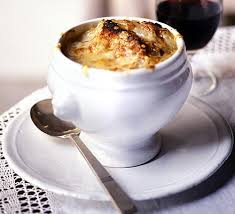
 French Onion Soup - a Classic !

After trying so many different recipes for French Onion Soup and not being really sure if I liked it or not,  I finally came up with my own. So far whoever ate it - loved it!

Serves 4

1/2 stick (1/4 cup) unsalted butter
2 lbs yellow onion cut into slices (makes approx. 6 cups)

2 tsp sugar if you use Cognac
1 tsp sugar if you use Sherry or Port
1 tbl (heaped) flour
1 Sachel (I use a porcelain tea egg hanging from the side of the pot) with 6 thyme sprigs, 12 peppercorn and 2 bay leaves) for the beef broth
3 1/2-4 cups of boiling beef stock (1 1/2 "More than Gourmet" Demi Glace Gold from FreshDirect)
2 cups of water
1/4 cup cognac (4 tbl)
1/2 tsp salt (or to your liking)
1/2 tsp fresh ground pepper
12 stale french bread slices or enough to cover the soup
1 lb Gruyer (or mixed with Emmenthaler), half coarsely grated and half thinly sliced

  • Melt butter over moderate heat in a large saucepan. Add onions and sugar, cover and cook for approx. 20 Min. stirring occasionally until wilted and of a light golden color.
  • Uncover and continue cooking for another 25 Min. until brown and well caramelized. Don't forget to stir often, so the onions do not burn!
  • Add flour to pan an stir well to incorporate the flour into the onions. Then slowly stir in the boiling (!) beef broth, water, 2 tbl Cognac (or Sherry/Port), salt and pepper. Boil for a few minutes and then turn down and let the soup simmer for about 45 minutes partially covered. (While the soup is simmering toast the bread slices - Toaster is the easiest). After 45 Minutes uncover Soup and cook for another 10 Minutes. Adjust seasoning and add the last tbl Cognac. 
  • Divide the soup into 4 ovenproof soup bowls, arrange the  bread slices, sprinkle the cheese generously over the bread and drape the wide thin slices of cheese over the side of the bowls. It prevents the cheese from slipping off the rim of the bowl. Put under a preheated broiler until the cheese melts and has a golden brown color.
Accompany with a nice Organic Baby Romaine Salad with Olive oil and a splash of Balsamic Vinegar - the older the better) and a glass of French Red Wine.

Bon Appetit! À Votre Santé!